
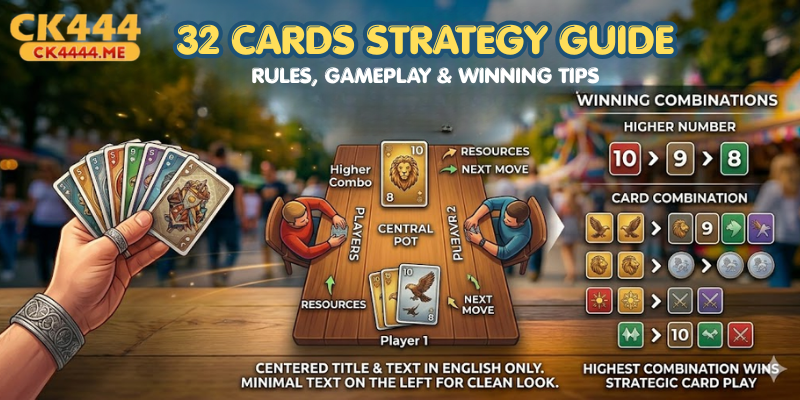
In the modern world of competitive card entertainment, CK4444 has become a recognizable reference point for players seeking structured gameplay experiences and strategic depth. Among the most discussed formats in online gaming communities is 32 Cards, a system that blends skill, probability, and decision-making into a compact yet highly engaging structure. Many beginners are drawn to 32 Cards because it offers both simplicity in rules and complexity in strategy, making it suitable for casual and advanced players alike.
At its core, 32 Cards represents a streamlined card format that challenges players to think critically while adapting to unpredictable outcomes. As the popularity of 32 Cards continues to grow globally, understanding its mechanics, strategies, and common mistakes becomes essential for anyone who wants to improve performance and consistency.
Understanding the Core Concept of 32 Cards
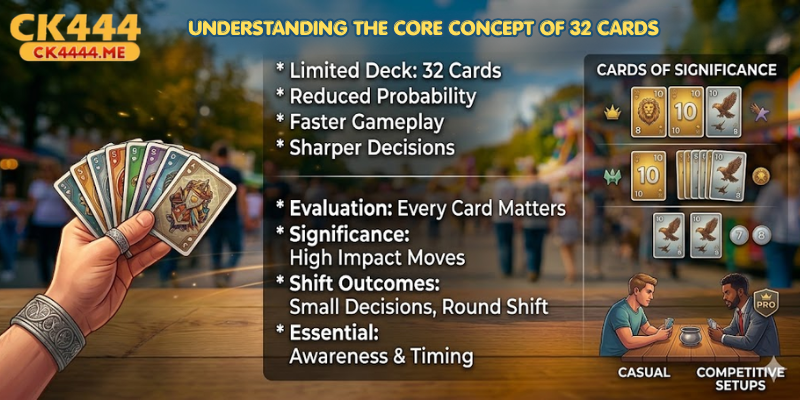
The foundation of 32 Cards lies in its reduced deck structure, which creates faster gameplay and sharper decision-making. Unlike traditional card games that rely on full decks, 32 Cards uses a limited set that increases probability concentration and strategic tension.
This format forces players to evaluate every move carefully, as each card carries higher significance. In 32 Cards, even a small decision can shift the outcome of an entire round, making awareness and timing essential skills.
Another important aspect of 32 Cards is its adaptability. It can be played in casual environments or competitive setups, depending on the ruleset being applied. This flexibility is one of the main reasons 32 Cards has maintained long-term popularity among card game enthusiasts.
Rules and Gameplay Mechanics of 32 Cards
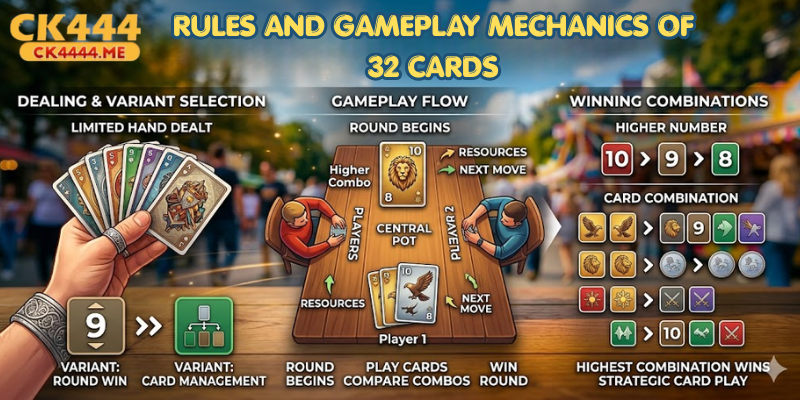
The rules of 32 Cards are straightforward, yet they allow for deep strategic layers. Each player is dealt a limited number of cards, and the objective varies depending on the specific variant being played. However, most versions of 32 Cards emphasize winning rounds through higher combinations or strategic card management.
Players must understand card hierarchy, turn structure, and timing. In 32 Cards, predicting opponent behavior is just as important as managing your own hand. This balance between offense and defense is what makes the game engaging.
Key Structural Elements in 32 Cards
One of the defining features of 32 Cards is its simplified deck structure, which removes lower-value cards to increase competitive intensity. This structure ensures that every round of 32 Cards feels dynamic and unpredictable, requiring players to stay alert and adaptive throughout the game.
Winning Strategies for 32 Cards

To succeed in 32 Cards, players must develop both analytical thinking and psychological awareness. Winning is not only about the cards you hold but also about how you interpret the flow of the game.
A key strategy involves tracking patterns. Experienced players of 32 Cards often observe opponent tendencies to anticipate future moves. This allows them to make calculated decisions rather than reactive ones.
Positioning and timing also matter significantly in 32 Cards. Knowing when to play aggressively or defensively can determine the outcome of an entire match. Many professionals emphasize patience as a core skill in mastering 32 Cards.
Mid-game adjustments are equally important. In advanced communities, platforms like kx8 are often referenced when discussing optimized gameplay environments and strategic tools related to 32 Cards analysis.
Another essential strategy is resource control. In 32 Cards, every card has potential value, and wasting even one opportunity can lead to long-term disadvantages. Skilled players maintain balance between risk and reward, ensuring they maximize efficiency in every round.
Common Mistakes Players Make in 32 Cards
Despite its simple structure, 32 Cards often leads new players into predictable traps. One of the most common mistakes is overconfidence. Many beginners assume that early success in 32 Cards guarantees consistent performance, which is rarely true.
Another frequent error is ignoring probability. Because 32 Cards uses a reduced deck, calculating odds becomes even more important. Players who fail to consider probability often make poor decisions that cost them the game.
Emotional decision-making is another major issue. In 32 Cards, frustration or excitement can lead to rushed moves, which skilled opponents can easily exploit. Maintaining composure is crucial for long-term success.
Lack of adaptation is also a significant weakness. Since 32 Cards requires continuous adjustment based on evolving game states, rigid strategies tend to fail against experienced opponents.
Advanced Insights and Competitive Play in 32 Cards
At higher levels, 32 Cards becomes a game of psychological warfare and predictive modeling. Players begin to focus less on individual hands and more on long-term behavioral patterns.
Advanced competitors in 32 Cards often study opponent habits across multiple rounds, identifying subtle cues that indicate strategy shifts. This level of analysis transforms 32 Cards from a simple card game into a complex strategic system.
Another advanced concept involves controlled unpredictability. Skilled players intentionally vary their behavior in 32 Cards to avoid being read by opponents. This creates uncertainty and forces mistakes.
Community-driven platforms and discussions continue to evolve around 32 Cards, contributing to its growing strategic depth and global appeal.
Why 32 Cards Continues to Grow in Popularity
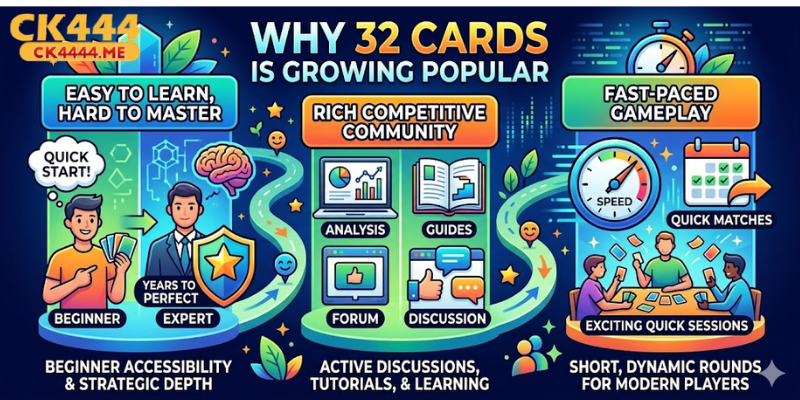
The sustained popularity of 32 Cards can be attributed to its balance between accessibility and depth. New players can learn the basics quickly, while experienced players can spend years mastering advanced techniques.
Another reason for its growth is the competitive ecosystem surrounding 32 Cards. Online discussions, strategy guides, and community analysis have made the game more engaging and educational.
Additionally, the fast-paced nature of 32 Cards makes it ideal for modern audiences who prefer quick yet meaningful gameplay sessions.
Final Thoughts on 32 Cards Strategy
In conclusion, 32 Cards remains one of the most engaging and strategically rich card formats available today. Its combination of simplicity and depth ensures long-term appeal for both casual and competitive players.
Understanding 32 Cards requires patience, observation, and continuous learning. Players who invest time in mastering its mechanics often find themselves improving not only in gameplay but also in strategic thinking overall.
For those looking to explore more structured gaming environments and additional resources related to card strategy, platforms such as kx8-1.com provide further insights and community-driven content that can enhance your understanding of 32 Cards and its evolving ecosystem.


